|
|
History of Homeopathy |
|
The
homeopathic system of medicine was developed
at the end of the eighteenth
century by a German
medical doctor, Samuel Hahnemann and it has
successfully treated countless people for
some two hundred years, for both acute (sudden)
and chronic (long - term) illnesses. Yet,
even today, it is seen as an ‘alternative’
system, and sometimes viewed
with suspicion, despite the fact that
some of the theories involved have an
extremely long and respected history. |
|
|
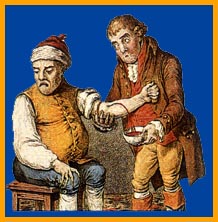
For hundreds of years, blood-letting was regarded by the medical profession as a cure-all for many diseases. |
At
the time of its
introduction, homeopathy certainly was a radical
breakaway from
the way in which medicine had been
practised in Europe for hundreds of years.
This had culminated in an orthodoxy
which advocated the use of leeches,
cupping ( using cups to draw the
blood to the surface) and frequent blood-letting for
almost any disease, together with strong cathartics
(purgative drugs), emetics ( drugs to cause
vomiting ) and other powerful drugs of
vegetable and mineral origin, often dispensed in extremely
high doses and complex mixtures. Treatment could kill the
patient as well as the disease. |
|
Hahnemann
was so appalled by the dubious methods used
by his profession that he abandoned
his work as a doctor. However, he continued to
be deeply interested in medical
theory and in 1790
he hit upon the homeopathic principle
that like could be cured (and
should be treated) by like. A
brief look at the
history of western medicine will
show what Hahnemann was reacting to and to
what extent his theories were new or formed part
of the thinking of earlier traditions. |
|

|
|
|
|
|
|
| Samuel C h r i s t i a n Friedrich Hahnemann was born in Meissen, Saxony in 1755, the son of a porcelain painter. He was a very bright child, whose father used to encourage him by giving him 'thinking exercises’ and whose teachers waived his fees so that he could continue his education. By the age of 12 he was already teaching Greek to other pupils, and at 20 he had mastered eight languages, and began to study medicine, first at Leipzig, and then Vienna and Erlangen, where he qualified in 1779. He took up practice in Dresden, but he was to move residence many times. |
| Marrying
young, he soon became a father, and it was partly
this that made him despair of medical practice,
as he felt so wretched when his children were sick,
finding that he ‘could afford them no certain relief. He had quickly
established a reputation as a kind and conscientious
physician, who, despite his own lack of wealth,
often refused to accept fees for his work. He had worked
as a translator and language teacher
to support himself while studying and,
to augment his income, he continued to
take on translation work. Eventually, he
ceased to practice and instead pursued
studies in chemistry and
earned a living from his linguistic skills.
In 1789 he moved to Leipzig, and was Working as a medical translator when, in 1790, he discovered the homeopathic principle that like should be treated by like. He then devoted himself intensively to testing out homeopathic remedies and, after six years, was sufficiently convinced of their worth to publish an article alluding to the principle in a leading medical journal and to take up the practice of homeopathy. He went on to publish a treatise on homeopathy entitled Organon of Rational Medicine (1810) and a Materia Medica (1811-21) – the result of his systematic ‘provings’ of potential remedies. Hahnemann
began to arouse the hostility of apothecaries and physicians
– the former because they took
exception to a physician preparing his own
remedies (and taking their living away from them),
the latter because homeopathic
theories made nonsense of
their practice. In 1820, at the
instigation of the apothecaries, the government granted an
injunction against Hahnemann dispensing his own remedies.
But before this was put
into effect, he treated Prince Karl Schwarzenberg of Austria,
getting him to come to Leipzig as homeopathy was already forbidden in
Austria. The Prince,
much improved, wrote to King Friedrich of Austria urging
him to have the ban lifted. Unfortunately, the prince
died in October 1820,having taken orthodox medical advice and resorted
to bouts of heavy drinking. Hahnemann
was unfairly blamed, his work ridiculed
and his publications publicly burnt. In
1821, at the age of 65,
Hahnemann took refuge in Cothen, where he acted as court
physician to the Duke of Anhalt - Cothen, a
former patient. From this time on his many pupils
and followers were also subjected to
persecution as the medical orthodoxy closed
ranks. During his 14 years in Cothen, Hahnemann began a
lengthy work on the study of chronic diseases, the
first volume of which was published in 1828.
His
wife died in 1830 and in
1835
he married a second time, to a Frenchwoman, and went to
live in Paris. There he had an illustrious practice with rich
and poor alike receiving treatment daily in his rooms in
the rue de Milan. He died in
1843, aged
88. |